The cuffing plot
Tis the season to re-evaluate

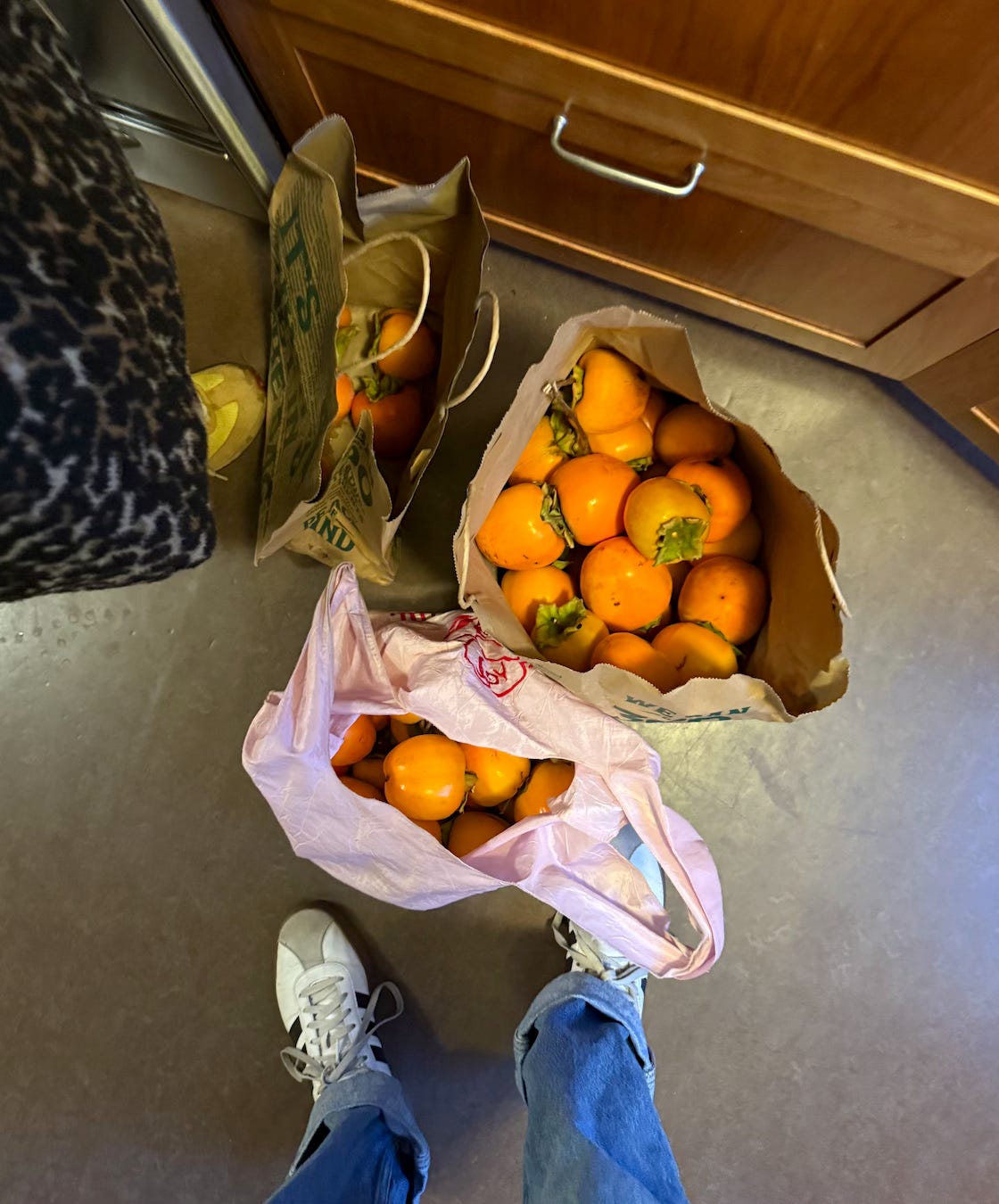
This week I met up with a single friend in her 30s. Sitting at the window table we now call the “wallow table” in a cozy-Christmas-light-lit-pub, we drank peppermint tea (her) and non-alcoholic Guinness (trust me) and let ourselves bitch. We did this a year ago and thought, hell, time again. We talked about financial anxiety, family pressure, the pros and cons of mind-altering-substances to help cope, and writing amidst self-doubt. I told her that during a particularly emotionally-and-meteorologically dark week, I started stockpiling really good breakfast items to pump me up for dark mornings, and watching a really good show (Prime Suspect with Helen Mirren, circa 1995, tysm Charley Locke for this rec) to pump me up for dark nights. Not saying the secret to sloggy days is bookending them with nice rituals, but you know, it helps!
Only after we hugged goodbye on the sidewalk, pausing to gawk deliriously at the Cold Moon between the clouds, did I realize we had not talked about any crushes. I knew vaguely what was going on in her love life, but mostly I knew she was dealing with other stuff. Love, or the pursuit of it, hadn’t risen to the top of what was most urgent and interesting. For an anxious orb of a minute I waffled over whether it had been rude of me, a partnered person, not to check-in about how my friend was feeling on this subject, then I remembered how touchy I’d felt not long ago when well-meaning pals asked “for updates” about my dating life, as if it were an unfinished home renovation project, its blueprints available for everyone to see. Western culture tells us that “to be in love is to be the protagonist of a story,” but all of us walk around with 1,000 stories stacked atop each other to fill out the trenchcoat of selfhood. Right now, other plots—other ambitions and frustrations—loomed larger in my friend’s life.

Erika Kirk recently made headlines suggesting that women in Zohran Mamdani’s New York City put off marriage because, essentially, having a socialist government that takes care of its citizens becomes “a form of replacement for certain things, relationship-wise.” When I read this, I thought: Well, that’s the dream, girl! We’re still a long way away. As K. R. Ghodsee puts it in Everyday Utopia: “It makes rational sense in economies with few social safety nets to embrace what social scientists call ‘hypergamy,’ or the desire to marry up and find a partner who can and will support them.” If you can’t afford a solo apartment, or get affordable healthcare from the government, yeah, you’re probably more motivated to hit the apps. I guess Kirk sees those resulting marriages as “success,” but is the help-me-I’m-drowning-relationship really good? In my experience, dating is most fun when you’re confident and secure in your own life. When you have the support to, without the other person, survive.
In her wide-ranging 1994 book Desire in Western Culture, literary critic Catherine Belsey writes about the strong cultural messaging that pushes us to obsess over coupledom at the expense of larger community and political issues. “The struggle to measure up, to establish a happy and wholesome sexual relation, to satisfy what might possibly be an insatiable desire, keeps us quite literally off the streets,” she writes. In imagining our needs can be met domestically, we let larger institutions off the hook. “Political intervention is hardly to be imagined as a source of happiness,” Belsey writes. “Social stability thus depends in more ways than one on the profoundly anti-social couple, cultivating their relationship, tending it, agonizing over its moments of crisis, anxiously watching it grow.”
Which brings me back to winter—the dark season when, traditionally, people hunker down and couple up. (“Christmas is an ad for heterosexuality” says Dire Straights). According to a recent article in Psychology Today, this is “cuffing season,” the time of year when Google searches for porn and dating websites, not to mention condom sales, peak. They attribute this surge to evolutionary factors like men’s testosterone peaking around the autumnal equinox. (Obligatory link to Callum Angus’ newsletter, which brings an invaluable queer and trans perspective to the very pop-sci-ready topic of “evolutionary behavior.”)
Walking around my Portland neighborhood at 7 p.m. the other day, I caught one silhouette after another behind glowing windows. Everybody was home. I didn’t blame them—I love being home when it’s dark outside, just like I love the heightened introversion of winter. At the same time, I’m uneasy with the hygge-bunkers that domestic spaces become when, for example, ICE is grabbing people off public streets. I keep thinking about what Sarah Brouillette wrote in an essay about heterosexual monogamy in Sally Rooney’s Beautiful World Where Are You?: that partners shelter behind closed doors to hide from bleak society, which in turn “makes society bleak, because care is then expected, and indeed structured, to take place there and not elsewhere.” Sure, this is a year-round problem, but it feels particularly acute during so-called “cuffing” season—when there is so much societal encouragement to curl into coupledom and away from the world.
I don’t have a grand argument here, nor am I writing with any smug disavowal of coupled convention. On a Sunday afternoon in September, Sam and I got married. (Legally cuffed, you might say?) Standing in a neighborhood park in front of local friends and family, we vowed to do all we could to help each other show up for art, and for the world. Our siblings officiated, then we paraded to a restaurant. Later, on the dance floor, I caught my friend’s child napping on my grandmother’s shoulder as both of them took a break from twirling. It was a perfect day.
But I keep thinking of a line from Belsey, who, amidst analyzing tropes of Western romantic plots in literature, notes that a “happy ending is also the unhappy end of the story, since the characters now move on to that transcendent domestic plane where they live happily ever after, immobilized by their own reciprocal happiness.” This is where the romantic comedy, so often, ends. Life, of course, isn’t like that. We keep yearning. But I keep being inspired by those people—single, partnered, agnostic to the whole thing—who keep yearning outward. Advocating for—I’m looking at you, Erika Kirk—better government “boyfriends” for all of us.
In her essay "Are We Horny For a Partner or For Community?” in Feeld Magazine, Megan Wallace advocates for flipping the script of cuffing season. “I think we should be focusing on cultivating an all-weather garden of intimacy,” she writes. By nourishing platonic friendships, we’re better equipped to “withstand the emotional freeze of the winter months.” She’s writing about the topic in the context of casual dating, but the message applies to all of us—even if I’m not sure she really wants my married, monogamous self under her umbrella. Wallace ends the essay with an ode to polyamory, observing that monogamy so often involves “creating something private, discrete, and removed from wider society.” She’s not wrong, I just refuse to accept it’s that black and white.
All of us can fight the societal pressure to become, as Belsey writes, “profoundly anti-social” rather than collectively engaged. All of us can consider what bigger ideas, projects, and aims we might cuff ourselves to this dark season.
What else?
I love Maya Dusenbery’s essay about coworking at the public library. (And, yes, I sat across from her at the library as she wrote part of it).
Applying for grants feels a little bit like knocking on wood—probably will not lead to a positive outcome—but a person feels compelled to do it anyway. I have applied for a bunch this year that amounted to nothing, but I feel wildly lucky to be one of 20 Oregon media and literary artists recognized with a Spark Award from the Miller Foundation. It’s for “mid-career” artists, and as Sam said: for once, it’s pretty cool to be “mid.”
On January 15, I’m joining the Biomimicry Institute for a Zoom talk about inherited stories of wildness, and January 28, I’ll be at Powells talking to Nina McConigley about her whipsmart new novel, How to Commit a Postcolonial Murder. Join us!
What are you munching/watching/doing to stay cozy, energized, and connected to other people this winter?!
xE
"hygge bunker" is such a great + disturbing turn of phrase!!
I appreciate so much about this post, particularly the idea of yearning outward and your resistance to black-and-white thinking.
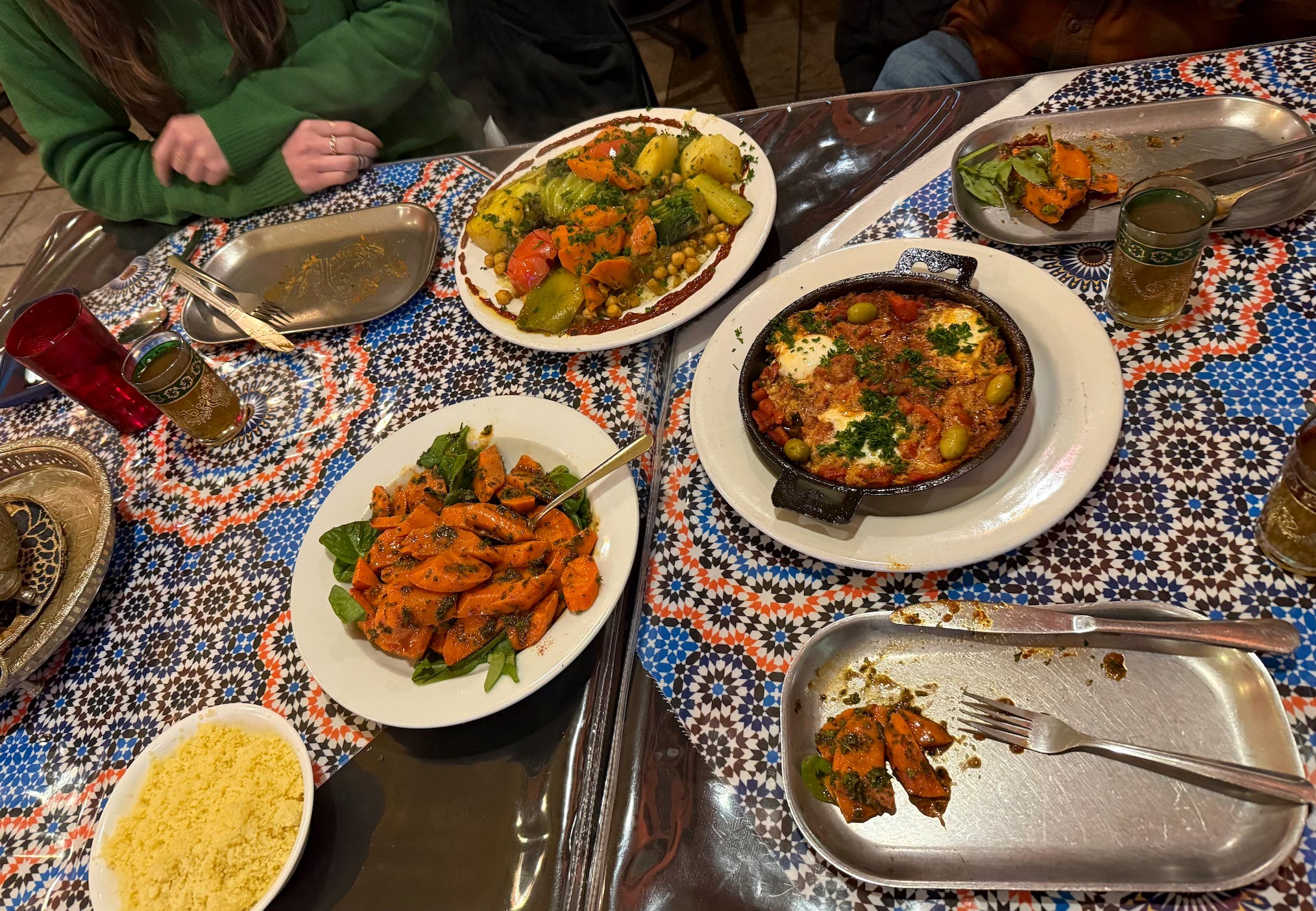
Also: I had the beet salad at Kasbah once years ago, and I still think about it with deep yearning approx. every 4-6 months. 😂